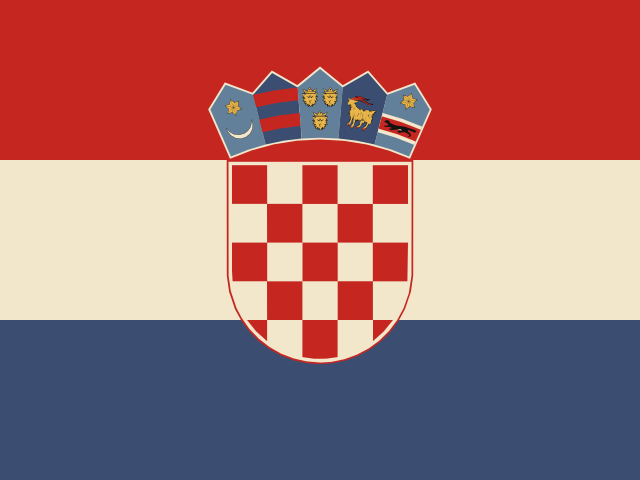
Croatia
- Capital
- Zagreb
- Language
- Croatian
- Money
- euro (€)
- Time
- UTC+01:00
- Dialling
- +385
- Emergency
- 112 or 192 police · 112 or 194 ambulance · 112 or 193 fire
- Drives on the
- right
- Plugs
- CF230 V · 50 Hz
Pick your passport
Do I need a visa?
on aYour passportChoosepassport
Check with the Ministry of Foreign and European Affairs
Visa data as of 16 Nov 2026 · for information only · check official source
Getting in
- Entry fee
- Not stated
- Departure tax
- Not stated
- Insurance
- Visitors from outside the EU, EEA or Switzerland may be asked at the border to: show proof of your accommodation, for example, a hotel booking confirmation or proof of address for a second home; show proof of your travel…
- Registration
- Your accommodation provider must register your arrival in Croatia with the police within 48 hours.
- Taking in
- You cannot take meat, milk or products containing them into EU countries. If you do not, your money could be seized when you leave.
- Jabs
- Routine vaccines · COVID-19 · Hepatitis A · Hepatitis B · Measles · Monkeypox · Rabies · Tick-borne Encephalitis · Yellow Fever — CDC lists advice for each
Money
- Prices
- 74 against the EU’s 100 (World Bank, 2025)
- Currency
- The euro — nothing to convert.
- Cards and cash
- Credit/debit cards are virtually everywhere accepted but there is no American Express acceptance in Croatia. ATMs (in Croatian bankomat) are readily available throughout Croatia.
- Cash machines
- Local ATMs add a fee of their own for foreign cards. Your own bank may still charge on top.
- Changing money
- Exchanging them at banks is however not free of charge; Croatia's national central bank will exchange kuna banknotes free of charge until further notice, and coins until December 2025.
Getting around
- From the airport
- Buses leave from the airport at 07:00 and every 30 minutes between 08:00 and 20:00.
- In Zagreb
- Zagreb has a well-developed and efficient public transport system that consists of trams, buses and trains.
- Trains
- Train travel is definitely improving in Croatia, with money being spent on updating the aging infrastructure and vehicles. Trains are clean and mostly on time.
- Buses
- A very comprehensive coach network connects all parts of the country. Bus service between major cities (intercity lines) is quite frequent, as are regional services.
- Flying
- National airline company Croatia Airlines connects major cities in Croatia to each other and foreign destinations.
- Ferries
- Croatia is endowed with a beautiful coastline which is best explored by ferry or yacht to access the hundreds of islands. Jadrolinija – the national ferry company.
- Taxi apps
- Uber · Bolt Uber and other rideshare services exist but have about the same prices except during surges. Uber — Works in Zagreb, Split. You can also order a taxi, Bolt or Uber.
When to go
Zagreb, the capital · average temperature, °C, and rainfall, mm a month · 1991–2020
- When not to go
- The continental part has a generally temperate continental climate, but with summers that are often very hot (average temperature: January -10°C to 5°C; August 19°C to 39°C), while mountainous areas at their highest…
- Next holidays
- 25 Dec Christmas Day26 Dec Saint Stephen's Day1 Jan New Year's Day6 Jan Epiphany28 Mar Easter Sunday29 Mar Easter Monday1 May Labor Day27 May Corpus Christi30 May Statehood Day22 Jun Anti-Fascist Struggle Day5 Aug Victory and Homeland Thanksgiving Day and Croatian Veterans Day15 Aug Assumption Day1 Nov All Saints' Day18 Nov Remembrance Day25 Dec Christmas Day26 Dec Saint Stephen's Day
Practical
- A local SIM
- tomato, 46 GB for 30 days, €6 as the SIM wiki lists it
- Tap water
- Tap water in Croatia is perfectly safe, and in some areas considered the best in the world.
- English
- Most younger Croats who grew up after the fall of Yugoslavia can speak English proficiently (especially in urban areas), but German and Italian are also very popular (largely because of historical reasons).
Food and drink
- Drinking
- Drinking in public is illegal but this is very rarely enforced, even less so when no glass bottles are involved.
Staying safe
- Scams
- Avoid strip clubs. They are often run by shady characters, and often overcharge their guests. Foreigners have been charged EUR 2000 for a bottle of champagne.
- Read up on
- Terrorism in Croatia · Protecting yourself and your belongings · Attacks and sexual assaults in taxis · Large gatherings, including football matches
Local laws
- Personal ID
- Always carry your passport or, if you’re a resident, your Croatian ID card.
- Antisocial behaviour
- In some Croatian town centres, including tourist destinations like Split and Dubrovnik, you can get on-the-spot fines…
- Illegal drugs
- Illegal drugs, including cannabis, carry severe penalties.
- Unexploded mines
- If you travel outside the tourist resorts, beware of unexploded mines in previously war-affected areas, including…
Where to go
Cities
- Zagreb the capital, has a fine old city.
- Dubrovnik is a spectacular walled city and UNESCO World Heritage Site.
- Osijek to the east is the chief city of Slavonia, with many budget flights.
- Pula is the main town of Istria with a well-preserved Roman amphitheatre.
Nature
- Brač is a long thin island, with Supetar its main port.
- Plitvice National Park is a spectacular scenic area and UNESCO World Heritage Site.
- Krka National Park is a river valley near Šibenik.
Sources: Wikivoyage, Wikipedia, FCDO, World Bank, Prepaid Data SIM Card Wiki, REST Countries, CDC, TerraClimate, holidays library. Licences and links.